It's time Indian F&B industry fixes its serious - yet neglected - shortcomings!
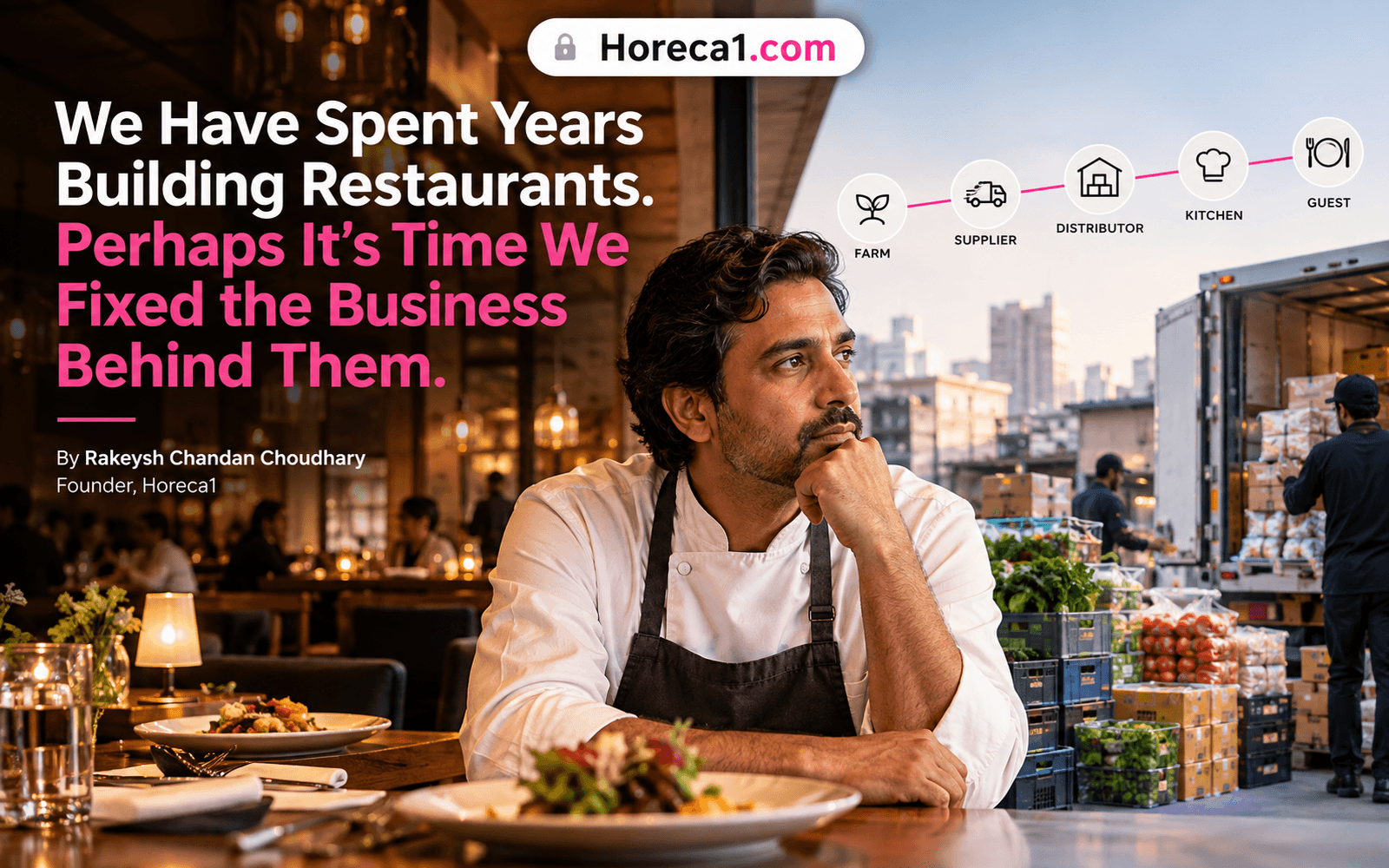
We Have Spent Years Building Restaurants. Perhaps It's Time We Fixed the Business Behind Them.
The Indian F&B industry has mastered the art of creating wonderful dining experiences. Almost!. But somewhere between the farm and the kitchen, we seem to have overlooked a rather important detail: making the business profitable.
By Rakeysh Chandan Choudhary | Founder, Horeca1
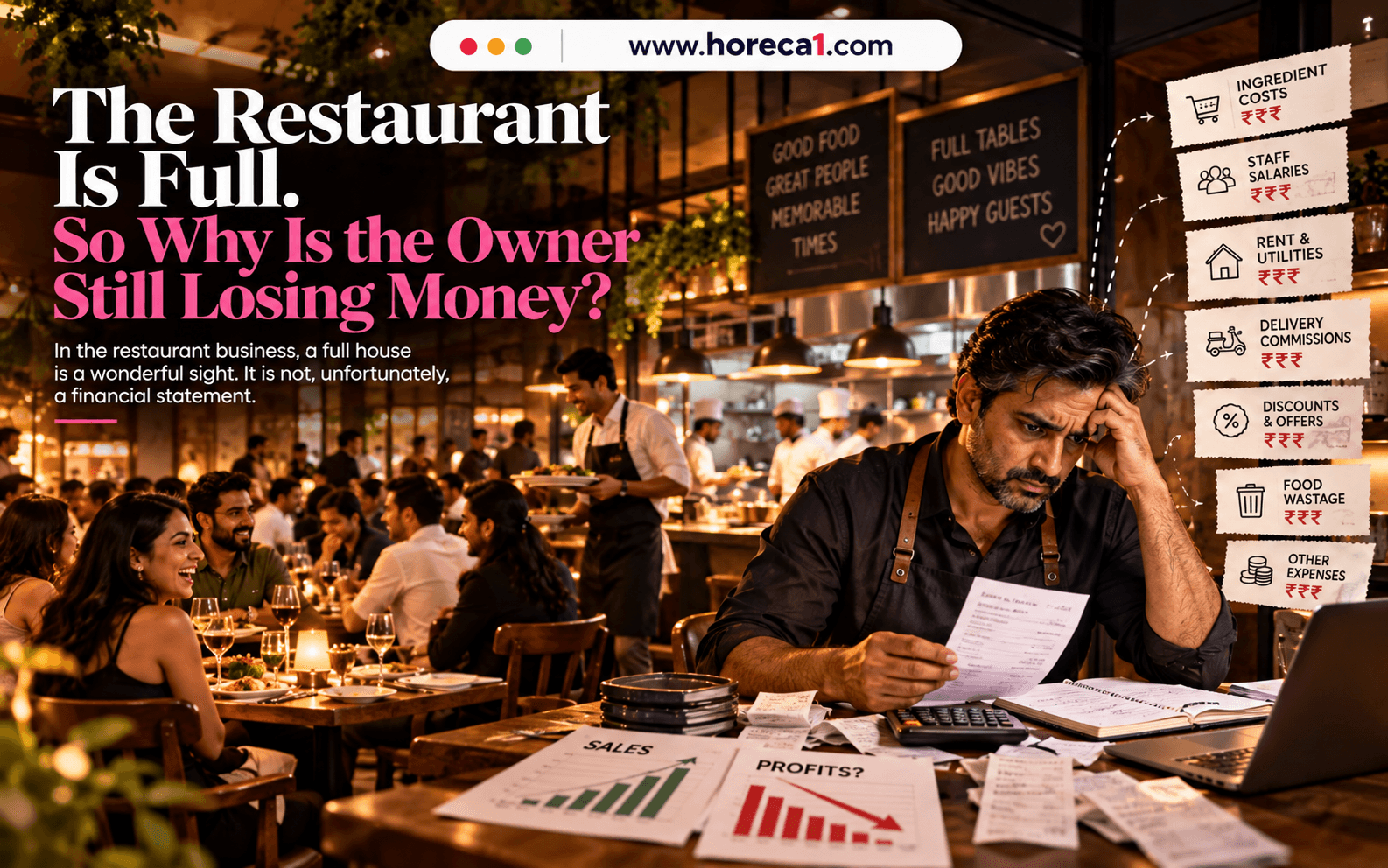
There is a peculiar contradiction at the heart of the Indian food and beverage industry. We have become remarkably good at building restaurants that people want to visit, yet an uncomfortable number of those restaurants struggle to make money. We have chefs creating extraordinary food, restaurateurs investing in beautiful spaces, brands expanding into new cities and consumers who are more adventurous about eating out than ever before. And still, for many operators, the end of the month brings a familiar exercise in arithmetic, where the revenue looks respectable, the restaurant has been busy, and the profit seems to have quietly slipped out through the back door.
I know this business from the inside. Having spent years running Rockville Bar & Diner and Rockville Deli, I have experienced the peculiar joys and frustrations of hospitality firsthand. I eventually sold the restaurants, but my interest in the industry never diminished. If anything, the experience left me looking more closely at a part of the business that receives remarkably little attention: the supply chain.
The more I examined it, the more I began to wonder whether some of the industry's most persistent problems were being addressed at the wrong end of the business.
We have invested heavily in the last mile of hospitality - the menu, the ambience, the service, the customer experience. Perhaps it is time we paid greater attention to the many miles that precede it.
# An industry of enormous scale, built on remarkably fragmented foundations
According to the National Restaurant Association of India's "India Food Services Report 2024", the Indian food-services market was valued at approximately INR 5.69 lakh crore in 2024 and is projected to reach INR 7.77 lakh crore by 2028. The sector employs millions of people and contributes meaningfully to the country's economic activity. These are not insignificant numbers; they represent an industry that has become an important part of India's urban and increasingly aspirational consumer economy.
Share this Inshorts Card
Spread recognition to fellow chefs, vendors, and restaurateurs.
And yet, much of the ecosystem supporting this vast industry remains fragmented.
A restaurant may have one supplier for fresh produce, another for dairy, a third for dry groceries, and several more for speciality ingredients, beverages, packaging and cleaning supplies. The larger establishments may have procurement departments and negotiated contracts, but for the vast majority of independent restaurants, buying remains a daily exercise in managing relationships, comparing prices, coordinating deliveries and hoping that what arrives is what was ordered.
A great deal of this still happens over telephone calls, WhatsApp messages, spreadsheets and the occasional handwritten note. There is nothing inherently wrong with relationships or with the local distributor who has served a restaurant faithfully for fifteen years. In fact, those relationships are among the industry's greatest strengths. The difficulty arises when an entire supply chain depends on individual memory, informal communication and fragmented information, with very little visibility across the system.
The result is an industry that may be sophisticated in the way it serves its customers, but considerably less so in the way it serves itself.
# The problem with believing that a good rate is necessarily a good deal
Ask a restaurateur how much they pay for an ingredient and, more often than not, they will have an answer. Ask them whether that is the best price available for the quality, quantity and delivery terms they require, and the answer may become less certain.
This is not a criticism of restaurant owners. It is a consequence of the market in which they operate.
When purchasing is spread across multiple suppliers, each with its own price lists, delivery schedules, credit terms and minimum order quantities, establishing a meaningful comparison becomes difficult. A supplier may offer a lower price but deliver inconsistently. Another may charge slightly more but save the restaurant from the occasional kitchen crisis. A third may extend credit, which is particularly valuable to an operator whose cash flow is perpetually under pressure.
The cheapest invoice, therefore, does not always represent the best procurement decision. But without adequate information, even an experienced restaurateur can find it difficult to distinguish between a genuinely competitive price and one that merely feels competitive.
This is where the economics of hospitality become particularly unforgiving. Food costs are among the most visible components of a restaurant's operating expenses, yet the manner in which those costs are managed often remains surprisingly informal. Small discrepancies in purchase prices, inconsistent quality, excessive inventory, wastage and emergency buying may seem inconsequential when viewed individually. Accumulated over hundreds of transactions and thousands of operating days, however, they can make a material difference to the profitability of a business.
The problem is not always that a restaurant buys badly. Sometimes, it simply has no reliable way of knowing how well it buys.
# The margin is often lost long before the food reaches the table
Consider a restaurant that has worked hard to improve its food costs. The chef has rationalised the menu, portion sizes have been reviewed, wastage has been reduced and selling prices have been adjusted wherever the market permits. The restaurant is busy, customers are returning, and the team is doing most things right.
Yet the business continues to struggle with profitability.
It is tempting to look immediately at rent, salaries or the price of a meal. These are important, of course, but the answer may also lie in the purchasing process itself.
Are ingredients being bought at competitive prices? Are quantities aligned with actual consumption? Is the restaurant maintaining excessive inventory because deliveries are unreliable? Are multiple suppliers delivering small orders when a consolidated purchase could be more efficient? Is the business paying a premium for last-minute availability? And how much time is being spent by the chef, store manager or owner coordinating purchases that could be managed more efficiently?
These are not glamorous questions. They are, however, questions that deserve to be asked.
The restaurant business is particularly vulnerable to the cumulative effect of small inefficiencies. Unlike many other businesses, it operates with a perishable product, a relatively fixed selling price and a customer who is unlikely to accept a sudden increase in the cost of their favourite dish simply because the price of an ingredient has risen.
There is only so much a restaurant can pass on to its customers. The rest has to be absorbed somewhere.
And that somewhere is usually the margin.
# We should be careful not to mistake the distributor for the problem
In conversations about the digitisation of hospitality procurement, it is easy to fall into the trap of treating the traditional distributor as an obstacle that needs to be removed. I believe this is a fundamental misunderstanding of the industry.
India's distribution network is an extraordinary achievement of entrepreneurship. Thousands of distributors and wholesalers have spent decades building relationships with brands, understanding their markets and ensuring that restaurants receive what they need, often at remarkably short notice. They extend credit, manage inventory, provide local knowledge and solve problems that a digital platform may not even know exist.
The distributor is not simply a middleman standing between the manufacturer and the restaurant. In many cases, the distributor is the very infrastructure that makes the relationship possible.
The question, therefore, is not whether we should eliminate this network. It is whether we can make it more efficient, more transparent and more commercially rewarding for everyone involved.
A distributor with a few hundred restaurant customers and thousands of SKUs is managing a complex business. Orders have to be received, stock has to be maintained, deliveries have to be scheduled, invoices have to be reconciled and payments have to be collected. Much of this is still handled through systems that were never designed to operate at the scale or speed that modern hospitality demands.
The opportunity lies in connecting these existing relationships through technology, rather than attempting to replace them.
This is also the direction taken by several businesses operating in the space. Zomato's Hyperpure, for instance, has built a substantial B2B supply business around the fragmented nature of restaurant procurement. Its FY2024 disclosures reported revenue of approximately ₹3,172 crore and more than 76,000 unique outlets billed. The scale of this operation is an indication of the opportunity that exists in solving a problem that restaurants have lived with for generations.
The market is clearly large enough to support meaningful innovation. What remains to be seen is how much more efficiently it can operate when the different participants are connected.
# The missing link is visibility
One of the more curious aspects of modern hospitality is that restaurants have become increasingly sophisticated in understanding their customers, while often having very limited visibility into their own purchasing behaviour.
A restaurant may know which dishes sell best, which customers return most frequently, what time its tables are occupied and how its marketing campaigns perform. Yet it may struggle to answer a relatively simple question: how much did we spend on a particular category of ingredients over the last six months, and how did those prices compare across our suppliers?
The information exists, of course. It is buried in invoices, purchase orders, spreadsheets, accounting systems and WhatsApp conversations. The difficulty is bringing it together in a manner that allows the business to make better decisions.
# This is where technology can make a meaningful difference. A connected procurement system can help restaurants discover suppliers, compare products, review pricing, place orders and maintain a clearer record of their purchases. For distributors, it can provide a more organised way of managing their catalogues, customers and orders. For brands, it can offer greater visibility into where their products are being sold and how demand is evolving across different markets.
And once these transactions begin to take place within a connected ecosystem, something more valuable emerges: data.
Not data collected through surveys or estimates of what restaurants might be buying, but actual purchasing behaviour. What is being bought, in what quantities, at what frequency, by whom and at what price.
That information can eventually help the industry make better decisions about inventory, pricing, distribution, promotions and even credit.
The possibilities are considerable, provided the technology is built around the realities of the industry rather than the other way around.
# A more connected supply chain could change the economics for everyone
Imagine a system in which a brand can identify the restaurants buying its products, understand the demand emerging in a particular geography and work with its distribution network to serve those customers more efficiently. A distributor could access a wider customer base without having to build an entirely new sales operation. A restaurant could discover additional suppliers, compare prices and consolidate purchases where it makes commercial sense.
Now imagine the same system generating enough reliable transaction data to help financial institutions better understand the purchasing patterns and creditworthiness of businesses that have traditionally been difficult to assess.
This is not an overnight transformation, nor is it a promise that technology will magically make every restaurant profitable. Hospitality will remain a demanding business, with all the operational, financial and human challenges that come with it.
But a more connected supply chain could remove some of the unnecessary friction that currently exists between its participants.
And that is a worthwhile ambition.
The benefits need not be confined to restaurants. Brands could gain better access to the market, distributors could improve their utilisation and reach, and suppliers could compete on a more level playing field. The restaurant, meanwhile, would have greater choice and visibility over one of its most important operating expenses.
The real opportunity is not simply to move transactions online. It is to improve the economics of the entire ecosystem.
# This is why I am building Horeca1
My journey with Horeca1 began with a fairly simple observation: the hospitality industry had spent years investing in the customer-facing side of the business, while the supply chain supporting it remained largely disconnected.
Having experienced the challenges of running restaurants myself, I was particularly interested in understanding how technology could help bring the different participants together. The ambition was never to build another catalogue of products and ask restaurants to change the way they did business. It was to create a platform that could work with the existing distribution network, give brands better access to the market and help restaurants make more informed purchasing decisions.
Horeca1 is still at the beginning of that journey. We have a great deal to learn, and I would be the first to admit that building a marketplace in a fragmented industry is considerably harder than describing one in an article.
But I believe the underlying opportunity is real.
We need more suppliers on the platform, because greater choice creates the conditions for healthy competition. We need more brands, because their distribution networks can help us reach more restaurants. We need more restaurants, because genuine demand makes the platform more valuable to the supply side. And we need to build the technology and data infrastructure that allows all of this to work together.
The ambition is to create an ecosystem in which the success of one participant contributes to the success of the others.
That is a very different proposition from simply selling products online.
# Perhaps it is time to look beyond the dining room
The Indian F&B industry has every reason to be optimistic about its future. Consumer demand is growing, the range of dining experiences is expanding, and entrepreneurs continue to bring remarkable creativity and ambition to the business. There is no shortage of people willing to build the next great restaurant brand.
But as the industry grows, we must also become more deliberate about the infrastructure that supports it.
A restaurant is only as strong as the business behind the experience it delivers. The food may bring customers through the door, but the quality of the underlying operations determines whether the business can sustain itself over time.
We have spent years perfecting the art of hospitality. Perhaps now we need to devote the same ingenuity to the less visible parts of the business: the sourcing, distribution, purchasing, inventory and financial systems that allow restaurants to operate efficiently.
The next meaningful improvement in restaurant profitability may not come from a new cuisine, a clever menu or another marketing campaign. It may come from something far less exciting, such as buying the right ingredients, from the right supplier, at the right price, with the right quantity and the right terms.
There is a certain irony in that. The most important innovation in hospitality may well be happening somewhere that the customer will never see.
And perhaps that is precisely where we should be looking.